
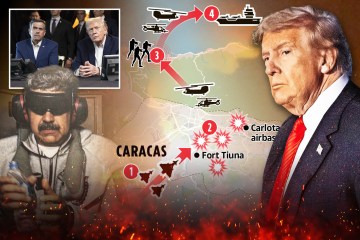

AFTER removing Nicolás Maduro from power, America’s biggest problem remains a hardline regime enforcer who could derail Donald Trump’s plans in Venezuela.
Diosdado Cabello is a defiant Maduro loyalist and a ruthless hardliner who leads the country’s security forces and brutal militias – all accused of widespread human rights abuses.
He is not the president, but he may now be the most powerful man in the country – and the one most capable of thwarting any US-backed transition in Venezuela.
The Trump administration has put him on notice that he could be at the top of its target list unless he helps Interim President Delcy Rodriguez meet US demands.
Cabello, a former army officer and one of the original architects of the left-wing Chavismo movement, has spent two decades at the core of Venezuela’s ruling machinery.
As interior minister, he oversees internal security, intelligence coordination and the brutal policing of dissent.
DARING RAID
How US forces captured Maduro after raiding safe house in ‘matter of seconds’

DON’S SUCCESS
Trump has Maduro where he wants – what happens next is crucial, expert says
In the chaotic hours after Maduro’s capture, Cabello moved quickly to project control, urging loyalists to stay mobilised.
He insisted that the revolution was intact, signalling that the regime’s coercive backbone had not collapsed even with Maduro’s ouster.
The brutal hardliner also has a swinging influence across pro-government street militias known as Colectivos, who were seen wreaking havoc across Caracas in the aftermath of the extraordinary US raid.
US officials are especially concerned that Cabello, given his record of repression and history of rivalry with Rodriguez, could play the spoiler in Washington’s plans.
They are now seeking to force his cooperation even as they look for ways to push him out of power and into exile eventually, a source told Reuters.
Cabello, who has also been indicted alongside Maduro, now faces a choice: back the interim government led by his rival or make a move and topple her to take it head-on with the US.
He has so far put up a show of unity with Rodriguez. But Cabello is hard to predict.
Any US-backed transition requires cooperation from whoever controls the country’s guns, prisons and streets.
In Venezuela, that man is Cabello.
Soon after the US raid, the streets of Caracas erupted in chaos as Maduro supporters took over the capital in solidarity with their toppled tyrant.
Highways leading into the capital were commandeered by armed men with AK rifles, stopping cars to search drivers’ phones and vehicles.
The checkpoints have been hastily erected by pro-Maduro militants.
Some Venezuelans are even too afraid to leave their homes as mobs with assault rifles roam the streets.
Cabello vowed to seek revenge and ordered his secuirty forces to crack down on Trump or American sympathisers.
US officials have they have communicated to Cabello via intermediaries that if he is defiant, he could face a similar fate to Madur or could see his life in danger, the source said.
But taking out Cabello could be risky as it could trigger motorcycle militias loyal to him to take to the streets, unleashing the chaos Washington wants to avoid.
The Trump administration has decided to work with Maduro’s allies for now out of concern that the country could descend into chaos if they tried to force a democratic handover and that an excluded member of the inner circle might foment a coup, according to one source.
But the administration wants to eventually see a move toward new elections, though the timeframe remains uncertain.
Trump has offered no clear explanation of how Washington would oversee Venezuela after the biggest US intervention in Latin America since the 1989 invasion of Panama.
He insists Washington is now “in charge” of the Caribbean country, but has said he is prepared to work with Rodriguez – provided she submits to his demand for access to Venezuela’s vast oil reserves.
Among the US demands for Venezuela’s leaders are a demonstration of willingness to open up Venezuela’s oil industry on terms favourable to U.S. companies, a crackdown on the narcotics trade, the expulsion of Cuban security personnel and an end to Venezuelan cooperation with Iran.
The US leader was startlingly direct about his intent regarding the South American country’s reserves, announcing on his Truth Social platform late Tuesday that Rodriguez “will be turning over between 30 and 50 MILLION Barrels of High Quality, Sanctioned Oil” to the US.
“This oil will be sold at its market price, and that money will be controlled by me” as president, Trump said, adding that he has tasked Energy Secretary Chris Wright with “immediately” executing the plan.
For now, Washington sees Rodriguez as its best bet to temporarily hold power while it continues developing plans for governing post-Maduro Venezuela.