
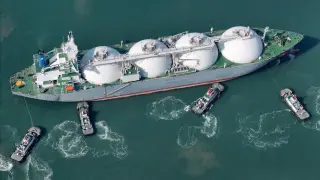

The president of the United States, Donald Trumpmet last Friday with the heads of the major American oil companies, ExxonMobil, ConocoPhillips y Chevronin addition to Repsol. Finally, the Anglo-Dutch also attended Shell and the Italian Enias well as the traders Vitol and Trafiguraand some more companies like India Reliance Industries Ltd.
Also present were officials from the American giants Halliburton, Valero y Marathon Petroleum Corp. y dOn the side of the federal Administration, the Secretary of State attended, Marco Rubio; the Secretary of Energy, Chris Wrightor the Secretary of the Interior, Doug Burgum. A meeting of the highest level and of “maximum importance” for the US executive, explain sources familiar with the meeting.
The meeting was a top priority since that some of these gigantic companies, the most capable of rebuilding the destroyed Venezuelan oil fields They were also skeptical when it came to injecting money into the country. We must choose between global “energy control”, which Trump seeks, or “energy dividends”.
Without political stability, the US “oil lords” do not want to risk billion-dollar investments to recover Venezuela’s industry. A position that is far from that maintained by Repsol, whose CEO Josu Jon Imaz assured that he was ready to “triple” his production in two or three years.
Given this lukewarmness when it comes to supporting the actions of the Trump Administration in Venezuela, the US Secretary of the Treasury, Scott Bessant, has warned that many small oil, mining and financial companies are clamoring for the opportunity to participate in the reconstruction of Venezuela. Not only that, he claims that they are saturating the White House phone lines to have the opportunity to do so.
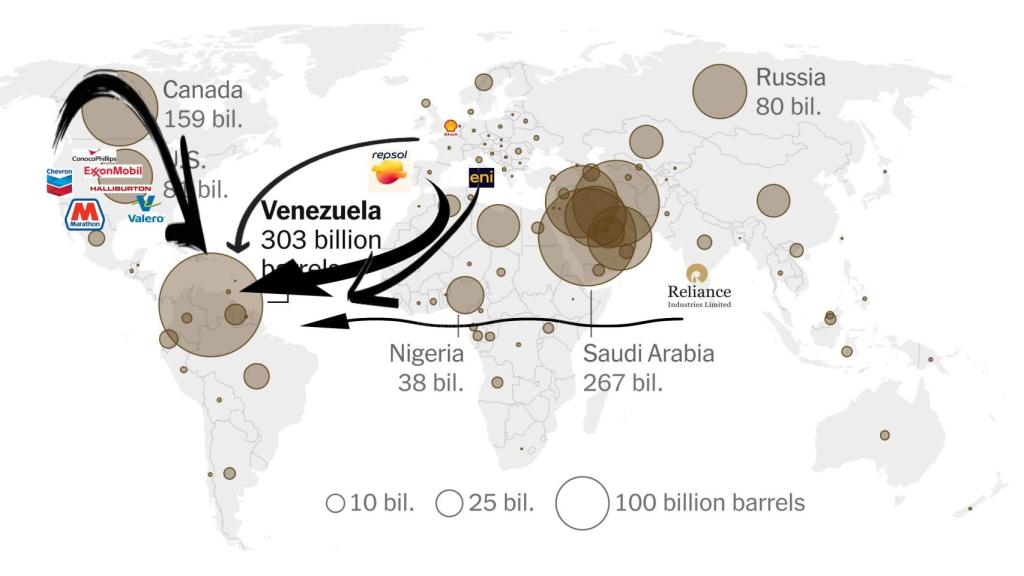
Map of the main world oil companies interested in Venezuela
These include private equity firms and companies seeking to build roads, build bridges, repair telecommunications services of the country, drill for oil and extract critical minerals in what decades ago had been one of the largest economies in South America.
But the US oil majors to which Venezuela still owes billions of dollars don’t just care about getting their money back. They are also afraid that any measure that increases the amount of crude oil on the market further depress oil prices.
Chevron
Chevron is the only major US drilling company operating in Venezuela. It has the ability to increase production there by 50,000 to 300,000 barrels a day for a year or more by repairing broken pipelines and other measures to reduce bottlenecks in the country’s infrastructure.
Until 2025, the only clear and explicit figure for Chevron’s losses attributed directly to Venezuela is the accounting impairment of some 2.6 billion dollars registered in 2020, by “bringing to zero” the value of its assets in the country.
In a series of conversations with Trump over the past year, the Chevron CEO Mike Wirthtold him that it was imperative that the United States had access to some of the largest oil reserves in the world and that he should not allow rivals like Russia and China will gain ground in them. Trump was receptive to those arguments, although he never advocated regime change.
ExxonMobil
ExxonMobil es one of the largest private energy companies in the world by capitalization, production and hydrocarbon reserves. He does not have a clear interest in investing in Venezuela, but rather a history of legal conflict with the Venezuelan State and an alternative bet to exploit crude oil off the coast of Guyana, in an area that Caracas wants as its own.
The company sued Venezuela in ICSIDachieving an award of about 1.6 billion dollars against PDVSA (the country’s state oil company) for the expropriation, which marked a break with the Maduro government.
ConocoPhillips
ConocoPhillips is one of the world’s largest oil exploration and production companies by proven reserves and oil and gas production. Its corporate headquarters is in Houston (USA) and is the third largest oil company in the United States by size and refining and production capacity.
Today it has a mainly collection and legal interest in Venezuela, rather than an operational one: its priority is to maximize and ensure the collection of awards for the expropriation of its assets, not to produce crude oil in the country again. In 2007, the government of Hugo Chávez nationalized projects in which the company participated, expropriating its assets. He ICSID condemned Venezuela to pay some 8.7 billion dollars.
Repsol in Venezuela
In Venezuela, Repsol produces gas, which is mainly used locally, but also has 50% of the gas field Perla (Cardón IV block), one of the largest deposits offshore from Latin America. The Venezuelan government pays Repsol with barrels of oil as compensation for an outstanding debt, but the sanctions of the last year and previous years drag them down a debt of about 2.48 billion dollars.
The Spanish multi-energy group also has operations upstream in the US, including a stake in a deposit in Alaska with the Australian oil company Santos. It also has an agreement with the American LLOG Exploration Offshore for the development of the Leon and Castile fields in the Gulf of Mexico.
Marathon y Halliburton
Marathon Petroleum Corporation is a major integrated American energy company, specialized in the refining, marketing and transportation of oil and derived products in the United States. It operates the largest refining system in the country and an extensive network of service stations under the Marathon brand, in addition to transportation and storage activities for natural gas and liquids (midstream) through its subsidiary MPLX.
Halliburton is one of the largest American oil and gas field services corporations, one of the largest technical suppliers to the energy sector on a global scale. Its business is not to produce oil directly, but to provide technology, equipment and personnel for oil companies to explore, drill and operate hydrocarbon fields.
Reliance Industries Limited (RIL)
It’s a conglomerate Indian private company based in Bombay (Mumbai), one of the largest business groups in the country by revenue and market capitalization.
It has been one of the main private buyers of Venezuelan crude outside the United States, using that supply to feed its refining macro complex in Jamnagar (India).
Many of these companies have had or have oil platforms, pipelines and other assets in Venezuela, depending on whether former President Hugo Chávez appropriated the assets of any of these companies to merge with the state-owned Petróleos de Venezuela.
For Venezuelan production to return to the levels of three decades ago, the oil industry would have to invest more than $10 billion a year and it would take more than a decade to pay off, according to the consensus of industry experts and the US Secretary of State for Energy, Chris Wright.
But by then, the US would have its 49th president, and unless there are last-minute surprises, Trump will not be able to be in the White House.