

Germany considers that the expansive trend of the European Union over recent decades has ultimately become a brake and a danger to its status as a world power.
Getting twenty-seven countries to agree with their twenty-seven agendas is very complicated, as has been seen recently in the delays in arms shipments to Ukraine or in the approval of the trade agreement with Mercosur.
All of this slows down Europe when the rest of the world lives in a continuous frenzy.
Once the Trump Administration has declared the trade and political war to the European Union and its values of diversity and understanding, the time has come, they think in Berlin, to take the bull by the horns.
The United States can no longer be trusted to protect the old continent in the face of military threats from Russia, commercial threats from China or the various internal conflicts that may arise.
In fact, Washington is pouring itself into supporting anti-european partiesthus seeking to undermine the European project, as witnessed by its national security memorandum.
Leaders like Viktor OrbánPrime Minister of Hungary, or Robert FicoPrime Minister of Slovakia, seem to be closer to the autocratic thesis of Donald Trump and Vladimir Putin than to the foundations of classical liberal democracy.
Within Parliament itself, parties such as Patriots for Europe, which includes the National Group of Marine Le Pento the Northern League of Matteo Salvinithe Fidesz of the aforementioned Orbán or the Spanish Vox, have been trying for some time to dismantle from within the very concept of a European Union to return to closed borders and “to each his own.”
Divergences in military spending
In this context we must understand the video call that the German Minister of Economy, Lars Klingbeilorganized last Wednesday with its counterparts from France, Poland, Spain, Italy and the Netherlands in order to create a “central nucleus” that provides rapid responses to current problems.
The objectives range from the economic – after all, these are the six most powerful economies in the eurozone – to the military: confronting US tariffs, finding a way to understand China… and working once and for all on a joint and independent security policy.
Klingbeil’s objective is to warn about the need to fully exploit rare earth minerals, so in vogue right now in the technology industry, and to agree on how much should be spent on defense.
Here, obviously, there will always be a problem.
France and Germany are very aware of the need to rearm. It also seems that Giorgia Meloni It goes in that direction, with active participation in NATO.
However, Spain has always been more reluctant when it comes to dedicating funds to military spending.
The reasons are economic—spending on defense, the government assures, would limit social spending and even the maintenance of pensions—but also ideological.
The Government of Pedro Sanchez It has carried the anti-militarist itch of the Spanish left since the eighties.
His disagreements with Trump have been notorious for refusing to raise up to 5% of GDP the defense budget. “I don’t know what’s happening with Spain, they’re on their own,” the magnate recently said.
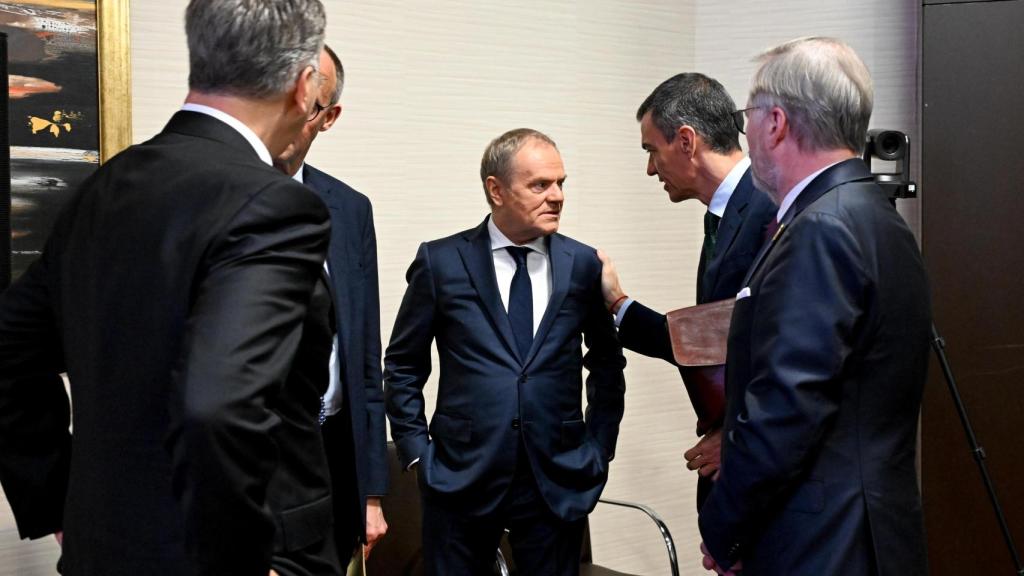
President Pedro Sánchez talks with Polish Prime Minister Donald Tusk during the emergency meeting of European leaders on Ukraine in Luanda (Angola)
Poland, key
At the opposite pole, we find Poland, whose importance within the European Union is increasing and which, after the dark years of the far-right governments, seems to have renewed its commitment to Brussels thanks to Donald Tusk.
Tusk is convinced of the need to protect himself from the Russian threat and has invested billions of euros in strengthening an army that, right now, in numbers and weapons, may be the most powerful in Europe.
Poland, precisely, is also one of the key allies for the common intelligence initiative proposed by the new Dutch government cabinet.
In October, two intelligence agencies in this country announced that they would stop sharing certain information with the United States, both out of concern for human rights and because of the lack of trust caused by a convinced pro-Russian Tulsi Gabbard at the head of the North American National Intelligence.
The objective is to create a coalition with France, the United Kingdom, Germany, the Nordic countries and the aforementioned Poland. A coalition that resembles the so-called “five eyes”, made up of the United States, the United Kingdom, Canada, Australia and New Zealand.
As can be seen, Spain is missing from this list, always viewed with suspicion from The Hague.
The great challenge, without a doubt, will be to develop these vanguards without the rest of the European countries feeling ignored and the decisions obtaining the greatest possible support. It doesn’t look like it’s going to be easy.