
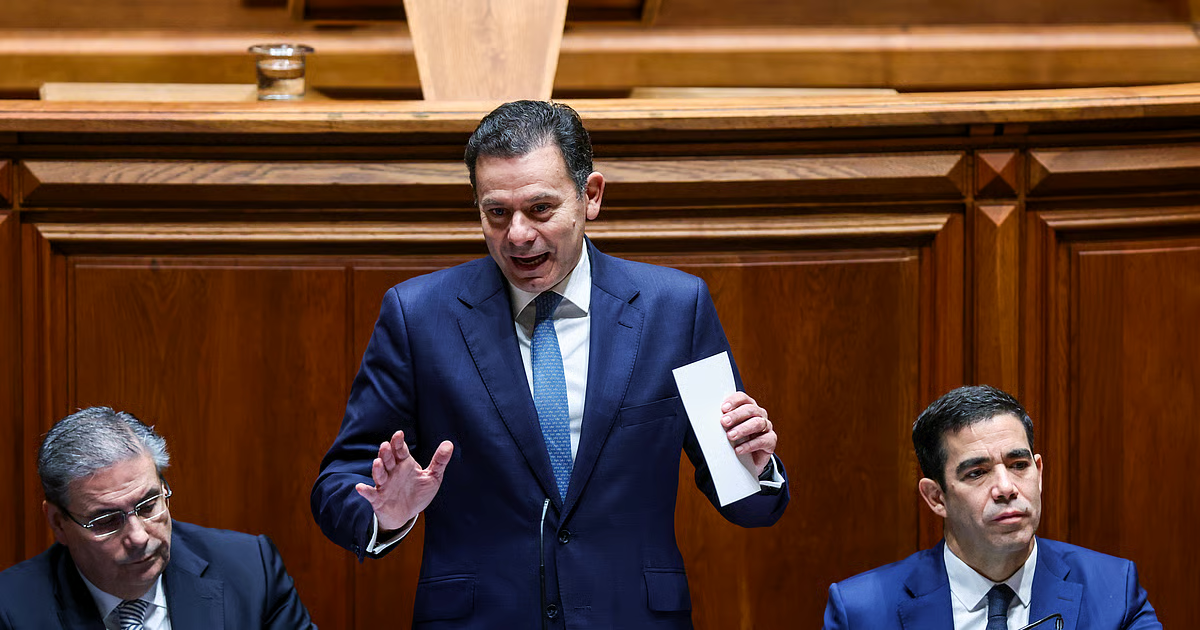

In a fortnightly debate held six days before the general strike, called by the CGTP and UGT trade unions due to planned changes to labor legislation, Prime Minister Luís Montenegro faced criticism from the left-wing opposition, and in particular from the PS, for the “immoral measures” that he assured were nothing that would not be found in European countries governed by socialist parties. But Chega also pointed out “incompetence” in its Government regarding the National Health Service, which led to the most notable incident on Friday morning.
“Man, what are you going to do to solve the health problem in Portugal?” asked André Ventura, taking the vice-president of the Assembly of the RepublicMarcos Perestrello, who presided over the work in Aguiar-Branco’s absence, to draw attention to the Chega leader for his “expression that was a little beyond reasonable”. This was how Ventura concluded an intervention focused on the “brutal civil war that our emergencies face”, warning of 18 hour waits at the Amadora-Sintra Hospital, the 1.5 million users without a family doctor and the 20% increase in the number of surgeries that exceeded the maximum waiting time.
The prime minister relativized, contextualized, accused the leader of the largest opposition group and presidential candidate of not wanting to be serious, but it was for the parliamentary leader of the PS, Eurico Brilhante Dias, who reserved the most acidic comments. Faced with the reaction that came from the socialist bench when saying that there were 390 cases of cancer patients waiting for surgery, Montenegro assured that “he also wanted them to be zero”, but clarified that “they are awaiting scheduling for clinical reasons”, adding, with his eyes on Brilhante Dias, that “it is too low not to respect the condition of people who find themselves in that condition”.
Also for Brilhante Dias, but especially for the general secretary of the PS, José Luís Carneiro, he left wishes for sweet dreams about his return to power, accompanied by the prediction that “they will have many years in the opposition”. Montenegro defended that the socialists “fell into the CGTP trap”, allowing themselves to be drawn into “a strike that makes no sense”particularly when the average income of Portuguese workers had the biggest increase in all OECD countries, increasing 6.7% in 2024, and the center-right majority carried out the fourth consecutive reduction in the IRS in the space of one year and eight months of government.
Regarding labor legislation, José Luís Carneiro cited the concerns of former ministers Silva Peneda and Bagão Félix, highlighting that they are a social democrat and a Christian democrat, with the way in which the process is being managed by the AD Executive. “Why is this when we are almost at full employment?” asked the socialist leader, arguing that the Government’s proposals contain “measures of an immoral nature that we cannot accept”. Something that led the Prime Minister to say that his rival “falls into exaggeration” when considering that the ongoing review constitutes a civilizational setback, challenging him to check what is in force in European countries governed by parties of his political color.
The PS secretary general also accused Montenegro of “making an Amending Budget”, after having promised deputies that he would not increase taxes, by reducing the tax discount on petroleum products, estimating that this increased tax revenue by more than 200 million euros. According to Carneiro’s calculations, it would be enough for the Government to lower the VAT rate on food by two percentage points.
The Prime Minister responded that he “is not available to auction proposals”preferring to “look at the tax structure” and decide “what is fairer, more economically sustainable and can give more predictability to people and economic agents”. And he did not spare attacks on the PS, guaranteeing that he did not want “fiscal adventures that could jeopardize the sustainability of our Public Finances”.
The same argument was followed by the prime minister when the PS secretary general highlighted that, according to the most recent budget execution data, the positive Social Security balance confirms his party’s forecasts, exceeding one billion euros, despite the Finance Minister, Joaquim Miranda Sarmento, having only “admitted at cost” that it could amount to 400 million. According to José Luís Carneiro, this shows that the Government “committed an injustice, also alongside Chega, by not increasing the lowest pensions”. Montenegro responded that it will wait until the end of this year to determine the true value, but recalled that the balance is applied to the Social Security Financial Stabilization Fund and will not be spent “on a permanent expense that could endanger this sustainability”.
The fortnightly debate began with an intervention by the social democrat Hugo Soares, leader of the largest group in the Assembly of the Republic, with many criticisms of the trade unions that called for the “political strike” that is expected to paralyze the country next Thursday. And in which he sought to dismantle arguments that the PS “repeats every day, as if it were an absolute truth”, against the revision of labor legislation.
Hugo Soares even mentioned the page numbers with references to the intention to move forward with the process, both in the Electoral Program and in the AD Government Program. “Forget the legitimacy argument, because that is false”, he concluded, also ruling out that the timing is wrong, as “reforms should not be carried out in times of crisis”, and that the proposed changes constitute “violence to parental protection”.
Nothing aligned with the Government and the Prime Minister in the last fortnightly debates, having heard accusations of radicalism on the part of Montenegro, the president of the Liberal Initiative, Mariana Leitão, criticized the creation of 80 working groups, as it implies “a duplication of functions” and suggested that “State reform must start with services” that do not work.
He also recalled that the ambition of having the national economy grow 3% per year, stated by Joaquim Miranda Sarmento when the PSD was still in opposition, is very far from being achieved. To the point of stating that stagnation is returning to Portugal. In response, the Prime Minister appealed to wait for the result of the policies that the Government is implementing, saying that economic growth will be the result of increased productivity and competitiveness that will generate better wages.
The parliamentary leader and co-spokesperson of Livre, Isabel Mendes Lopes, accused Luís Montenegro of bringing “instability to the country, to companies and to companies” with the draft reform of labor legislation, reaffirming that the changes “further accentuate prejudice against women”.
The Livre deputy defended the general strike on December 11th, as the Government “is retreating on workers’ rights”, before challenging Montenegro to withdraw the proposal that is being discussed with social partners in the context of social consultation. “It is the height of arrogance,” replied the prime ministerensuring that his Government intends to contribute to a “competitive economy, which favors workers and companies”. And it does not aim to “increase precariousness or harm workers in working hours or parenting policies”.
Very critical of the Government’s intentions was also the secretary general of the PCP, Paulo Raimundo, who accused Luís Montenegro of intending to impose “a law on the Americans”, in the logic of “you’re fired and there’s no reason to come back tomorrow”. Before, he challenged the Prime Minister to say the number of precarious workers in Portugal and, upon lack of response, he said that there are 2.7 million people “who work unregulated hours, with no time for themselves and their families”.
In response, Montenegro pointed out ideological prejudices against communists, highlighting that there will always be shift work and different hours within the scope of a competitive economy. And he said that Paulo Raimundo’s speech and the way he views labor reform “are dated and reveal the circumstance of someone who is not looking to the future”, but rather “to keep everything the same”.
In addition to the recent package of measures to “restore the confidence of families and owners” with regard to Housing, the biweekly debate was used by the parliamentary leader of the CDS-PP, Paulo Núncio, to criticize the broadcast of “Sex Symbols – Transgénero” by RTP2, considering that the television program in question, “clearly aimed at children, is pure propaganda of gender ideology”.
Núncio announced that his parliamentary group will propose a vote of protest against the broadcast of this type of programs on public television, wanting to know the opinion on the matter of a prime minister who “had the courage to say that he wanted to free education from the ideological ties of faction”. Montenegro responded that as a citizen he “deeply regrets that the program was issued under the terms in which it was”.
Among the single deputies, Blogger Mariana Mortágua took up a question from José Luís Carneiro, seeking to know what labor legislation standards the Government intends to adapt work to artificial intelligence and digital innovations, but the Prime Minister accused her of “trying to divert attention from what is important”saying only that “all articles follow this objective”, in that they dedicate adaptation “to the current requirements of the functioning of the Portuguese economy”.
For your part, Inês de Sousa Real, from PAN, recalled that the center-right majority refused to include measures to combat domestic violence in the State Budget for 2026hearing from Luís Montenegro that there was an increase in funds to protect children who are victims of this type of violence. And Filipe Sousa, from Juntos pelo Povo, was left without a response when he asked the prime minister for an opinion on the investments made by the Regional Government of Madeiraled by social democrat Miguel Albuquerque.