
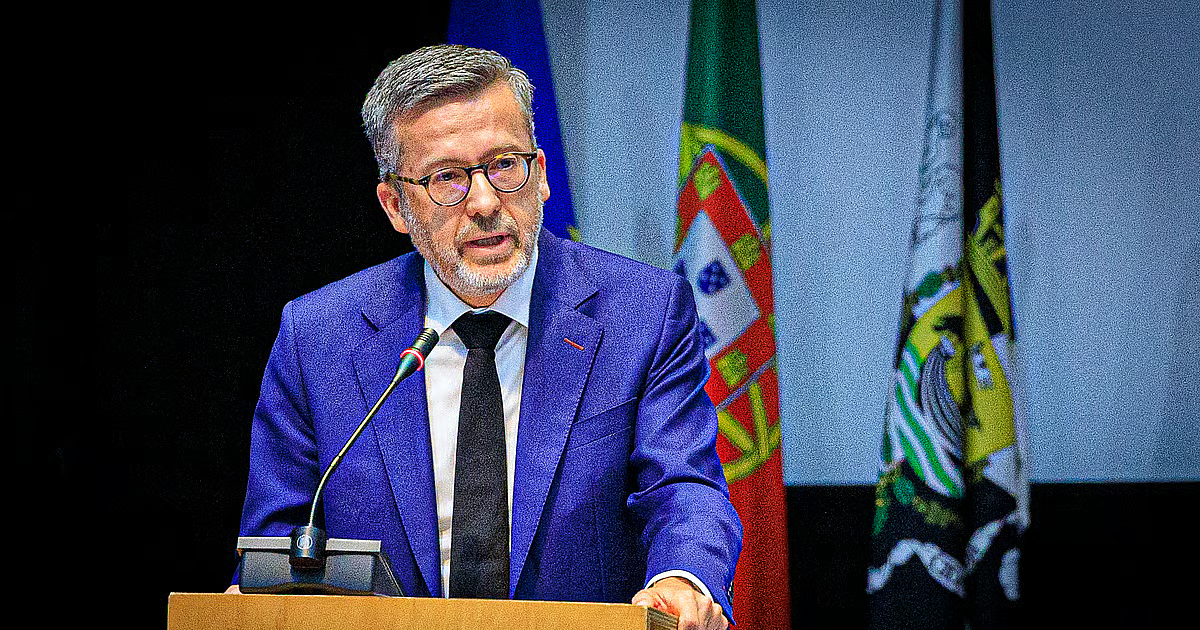

Carlos Moedas, mayor of Lisbon, defended this Saturday, December 13th, in Viana do Castelo, an effective and real decentralization of competences, which is not “a half-decentralization”, because mayors are not “government employees”.
During the opening session of the XXVII Congress of the National Association of Portuguese Municipalities (ANMP), Carlos Moedas, who is also president of the Congress Bureau, considered that “the basis of any democracy is precisely local power” and therefore, as a municipalist, he defended “a decentralization of competences” that “is effective and real”.
“We don’t want it to be a half-decentralization. We don’t want the municipalities to become taskmasters of the State. That they only fulfill tasks that the Central State does not want to fulfill. Reaffirming the principles of 1976 is reaffirm a decentralization that gives us true competencies in health, education, security to effectively serve people”these.
“Do not make mayors employees of the Government. We are not. We will not be. We are elected by the people”, he added.
Moedas recalled that in about a year, on December 12, 2026, 50 years will pass since the first democratic local elections, an “impactful” day, taking into account that before “there was no power of choice”, since mayors were appointed by the Government.
“But more than celebrating, we have to live up to that date (…) Basically, renew our vows with the country”, he said.
The mayor of Lisbon stated that he has heard “a lot of talk about reforming the municipal governance model” and asked that “not to start inventing”.
“I want to be clear on this topic: A mayor has the power he has, and the responsibility he has, because he is directly elected by the people. And that is how it should be. It is to the people who elect him that he must be accountable, for better or for worse”, he considered.
Moedas considered that the mayor “should not be elected or appointed by the Municipal Assembly, or see its executive elected or approved by the Municipal Assembly”.
“If we want to improve the relationship between local power and people, then put an end to the current composition of the executives, which is completely Kafkaesque. Having the opposition in the executive does not exist in any European democracy”, he stated.
“A mayor cannot lead an executive where there are councilors without responsibility whose sole objective is to block. A mayor has to govern with the councilors to whom he assigns responsibilities. He has to govern with a kind of executive committee”, he added, highlighting that this, “yes, is making local democracy effective”.
Carlos Moedas also highlighted that mayors also have to work for territorial cohesion, because the country needs “a dynamic and economically thriving interior”, to work for more housing and more innovation, because “it is in the municipalities where we see the creation of wealth and jobs”.
The XXVII Congress of the ANMP brings together, this Saturday and Sunday, in Viana do Castelo, hundreds of mayors elected in October, to discuss topics such as local finances, the autonomy of local power and the decentralization of powers.
In the first congress after local elections, Pedro Pimpão, re-elected president of the Chamber of Pombal (PSD), is the only candidate to succeed the socialist Luísa Salgueiro, president of the Chamber of Matosinhos.