

Companies have a “slightly positive” assessment of activity in the national and international markets this year and have better prospects for 2026, continuing to highlight bureaucracy as the main obstacle, according to a survey released this Tuesday, 16th, by AEP.
Promoted at the beginning of this month among 780 member companies of the Portuguese Business Association (AEP), from across the country and from various sectors of activity, the “Flash Survey: Perspectives on the evolution of business activity” found that 2025 registered a “slightly positive evolution in terms of the international market”, with more than 60% of companies reporting a maintained level of activity and around 26% recording an increase in activity.
Even so, around 17% of companies reported a decrease in their activity (13% slight and 4.3% very significant).
For 2026, the outlook improves, with companies expecting a decrease in activity falling to less than 9%, compared to more than 40% expecting to see an increase, with just under 50% expecting to maintain levels compared to 2025.
As for the national market, the evolution of activity in 2025 was also “slightly positive”, with almost 40% of companies registering a maintenance of activity and an identical level indicating an increase.
“It should be noted, however, that more than a fifth of companies reported a decrease in activity (around 9% slight and 13% very significant)”, notes the AEP.
For 2026, the outlook is more positive, with around 57% of companies expecting to maintain activity levels and almost 40% expecting an increase, compared to less than 5% expecting a slight decrease.
According to the association, the results also point “very clearly to the usual constraints that affect companies, with emphasis on excessive bureaucracy and high taxation, slow justice, licensing problems or difficulties in hiring”.
Bureaucracy is, by far, the most important obstacle, with more than 80% of companies considering that it significantly or very significantly affects their activity.
Protectionist measures and taxation follow, with one in three companies reporting protective measures as very significantly affecting their activity and taxation significantly or very significantly impacting more than 80% of companies.
The remaining factors presented – credit insurance, geopolitical tensions and financing – were considered to significantly or very significantly affect around 40% to 57% of companies.
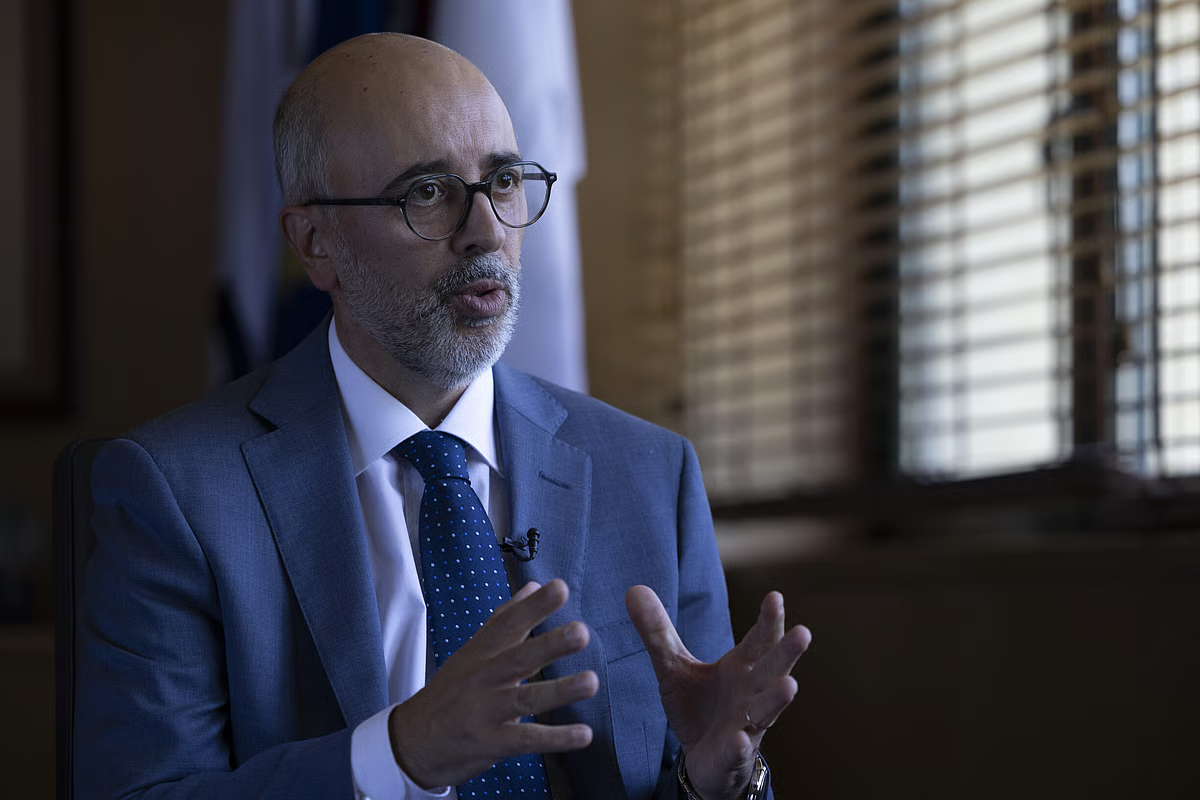
Speaking to the Lusa agency, the president of the AEP Board of Directors states that “the persistent contextual costs confirm that business activity continues to be excessively conditioned by factors that have nothing to do with the intrinsic capacity of companies, in terms of productivity or competitiveness”.
“And I’m not referring to the obstacles created by the adverse international framework, such as geopolitical instability or commercial protectionism. I’m referring to those placed ‘inside’, whose resolution depends exclusively on successive decision-makers of national public policies”, emphasizes Luís Miguel Ribeiro.
For the association leader, “it is urgent to correct these structural factors that compromise business dynamism, with an agenda focused on administrative simplification, the elimination of bureaucracy and an attractive and competitive labor legislation and tax framework, with an effective reform of public services, particularly those that affect economic activity”.
Regarding priorities in terms of international trade, companies highlighted the speed of European funds (with reduced payment deadlines for subsidies and incentives allocated) and support for exporting companies with high exposure to the US market.
They also highlighted financing, “namely for working capital so that we can invest immediately to find alternative markets”, as well as financial instruments that allow us to reduce risk and accelerate expansion into new markets.