

This Friday, December 19th, FC Porto saw arbitration as the main responsible for the instability in Portuguese football, lamenting a week of “controversy and incomprehensible decisions”, which “compromise the sporting truth” and increase the “loss of confidence in the sector”.
“The last elections for the Portuguese Football Federation (FPF) were accompanied by the promise of an evolutionary renewal in the area of arbitration, particularly in terms of programmatic lines and respective reforms. The balance of this almost first year of the mandate of the federative arbitration bodies is disappointing”, assumed the dragons, in a statement.
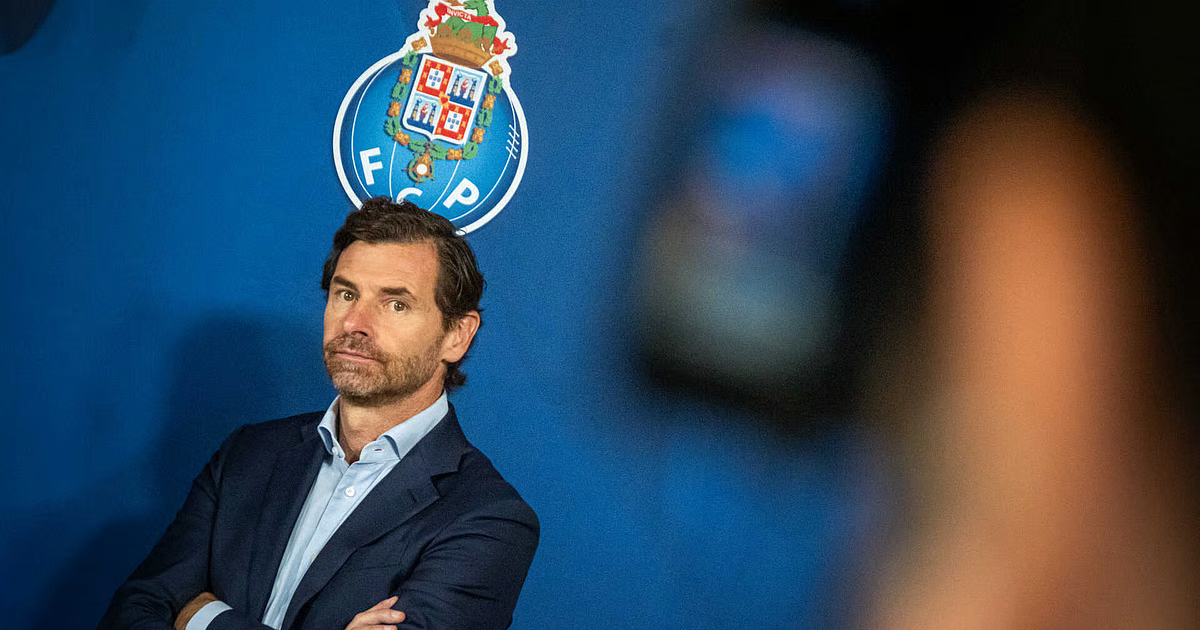
The board chaired by André Villas-Boas made a statement in a document with five points, aimed at arbitration a day after the controversial comeback victory by Sporting, two-time national champion and holder of the trophy, in their visit to Santa Clara (3-2), for the round of 16 of the Portuguese Cup.
FC Porto demanded from the president of the FPF, Pedro Proença, a “deep consideration and the adoption of urgent measures” regarding the functioning of national arbitration and the performance of the people chosen to lead the sector, namely Luciano Gonçalves, leader of the Arbitration Council (CA), and Duarte Gomes, national technical director.
Convinced that this two-headed leadership “has contributed nothing” to the serenity of the referees, the dragons, current isolated leaders of the I League, denounced an “erratic, non-transparent and deeply destabilizing system for those who, on a weekly basis, are responsible for making decisions within the four lines”.
“The disastrous communication policy followed by the current CA, the glaring lack of consistency in the criteria for evaluating similar bids, the insistence on validating obvious errors and a model for awarding grades whose relationship with merit criteria and whose impact on subsequent appointments are not adequately clarified are, in FC Porto’s opinion, susceptible to sowing doubts, discord and technical instability in the arbitration teams, with a special focus on video arbitration (VAR)”, he assumed.
FC Porto also recalled having questioned Pedro Proença and Luciano Gonçalves about the composition of the FPF’s non-permanent arbitration commission, led by Duarte Gomes and made up of arbitration commentators linked to media outlets, plus a representative of clubs from both levels of professional football, in this case Patrícia Silva Lopes, Sporting’s legal advisor.
In addition to doubting the nature of these people’s ties to the organization, the ‘blue and white’ club questions whether “the continuous exercise of commenting on arbitration in media outlets, combined with the exercise of technical or consultative functions in the sphere of FPF arbitration, is in line with principles of credibility, objectivity and reserve”.
“The influential position that these members appear to have within the committees, combined with the public echo of their opinions and their direct association with the FPF, exposes the arbitration teams in future decision-making and the standardization of criteria”, he considered.
The ‘dragons’ recognized that the benefits of body cameras in the referees’ equipment – a measure debuted this week in Portugal – “were reduced to television cosmetics”, given the controversial move already in the compensation period in the match in the Azores.
Referee João Pinheiro stood on the pitch for 12 minutes, before being called by VAR Rui Silva to consult the images of a foul by Tiago Duarte on Morten Hjulmand in the Santa Clara area and award a penalty in favor of Sporting, who lost 2-1, but took the game to extra time with a goal from Luis Suárez.
“Perhaps it would be more appropriate, in the name of much-vaunted transparency, to definitively resolve decisive issues, such as the standardization of VAR technology in all stadiums and the implementation of goal line technology and semi-automatic offside, as well as the immediate availability of VAR audio”, he indicated.
Wishing that “this season will be decided exclusively by the protagonists on the field”, FC Porto says it has not found dynamism within the FPF and the Portuguese Professional Football League (LPFP) for the rapid implementation of these proposed measures.