
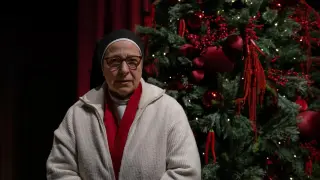

Celebrating Christmas in Ukraine on December 25 has become a weapon of resistance against Russia, and against the imposed traditions by the church of Moscow Patriarchate, for whom Orthodox Christmas Eve is commemorated on January 6 – with strict fasting – and the birth of Christ on the 7th.
However, Ukrainians cling to European roots and traditions. Even on the front lines, Zelensky’s soldiers place trees and colored lights inside the trenches.
Ukraine has the third largest Orthodox population in the worldbut not all Orthodox countries use the same liturgical calendar for their celebrations. While most European countries that profess this religion are governed by the Gregorian calendar, in Russia they use the old Julian calendar – which delays Christmas by 13 days, and other important dates such as Saint Nicholas or Easter.
Although Ukrainians put more emphasis on celebrating the New Year –moment in which the majority of the population exchanges gifts–, traditionally Ukraine also celebrated Christmas on the 25th. The change to the Julian calendar was consolidated between 1918 and 1923, when the Soviet Union entered the country like a steamroller.
During the years when Ukraine was part of the former USSRon December 25 it did not disappear completely. In many homes the tradition was maintained, although in a more intimate and discreet way, to avoid accusations and possible political consequences. For this reason, after the country’s independence, the celebrations of both liturgical calendars were intertwined normally.
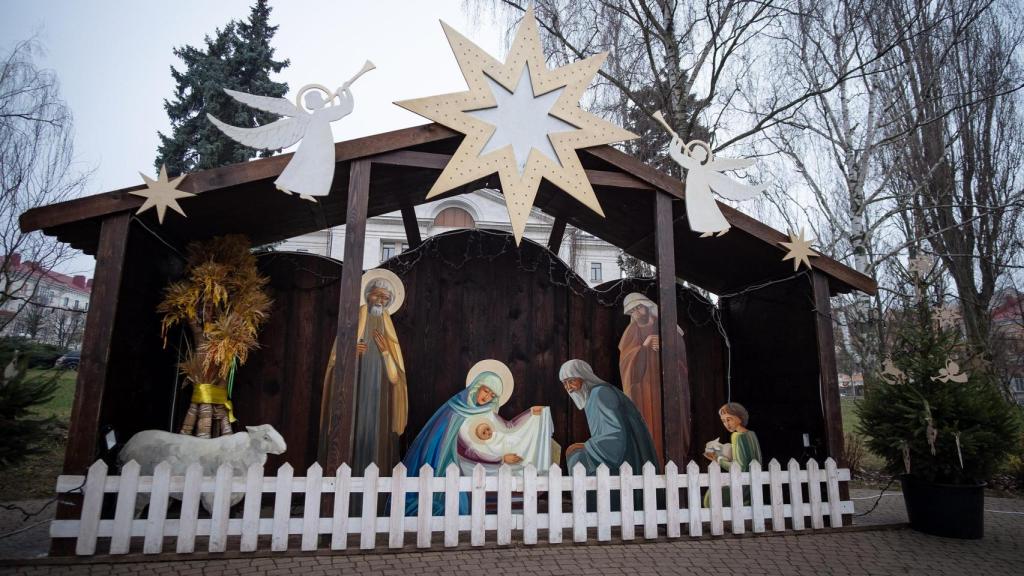
Bethlehem Portal installed in the center of the city of Chernigiv, northern Ukraine.
Maria Senovilla
But when the war in Donbas in 2014, The tensions between the churches subordinated to the Moscow Patriarchate and the rest of the parishes began to become palpable. Finally, in December 2018, both branches separated and the Orthodox Church of Ukraine was formed – which returned to the Gregorian calendar.
The great rupture at the social level occurred after the large-scale invasion of 2022, when the Patriarch of Moscow Kirill – very close to Putin – refused to condemn the war actions and blessed the Russian troops who were carrying out the invasion, provoking another parallel war on the religious level.
Shoot a priest
The matter hit the international press when the Priests of the Moscow Patriarchate barricaded themselves in the kyiv Caves Monasteryin response to the Government’s mandate that urged them to leave the place. However, although it was less known, this rejection of the Moscow Patriarchate occurred in parallel in many other cities in Ukraine, where the civilian population began to distance itself from this church.
Es Ivankiv’s casea town located 80 kilometers north of kyiv, which was occupied by Russian troops at the beginning of the invasion. “I was appointed to this parish in May 2022, until that moment the church belonged to the Moscow Patriarchate,” explains the current parish priest, Father Ivan.
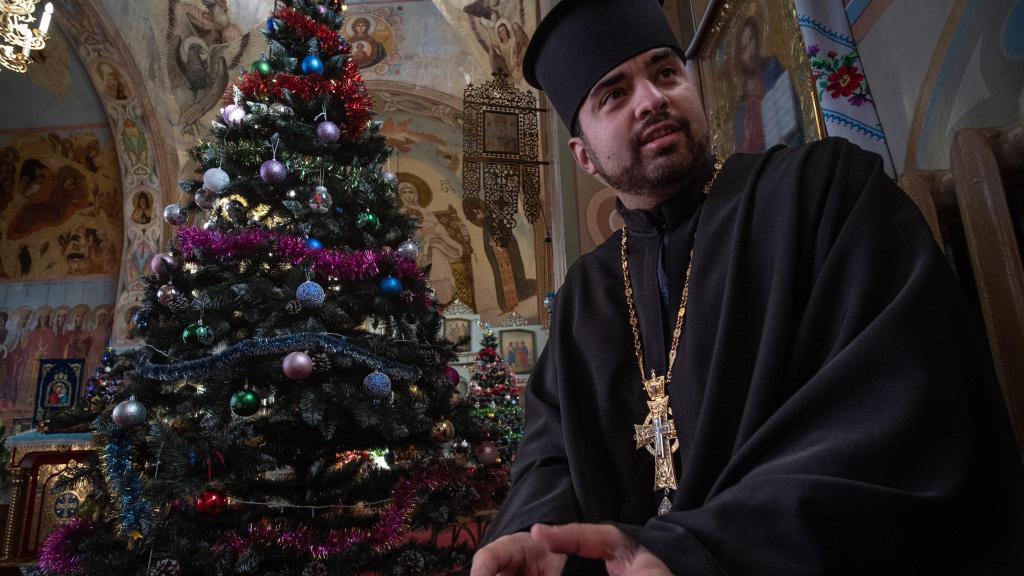
Father Ivan, priest at the head of the Orthodox Church in the city of Ivankiv since May 2022.
“Although the community’s decision to change jurisdiction had occurred much earlier: here there was great unrest with the Moscow Patriarchate since they refused to celebrate ehe funeral of the city’s first soldier to fall in combat, in Donbas, in 2014.”
That funeral had to take place in the Ivankiv House of Culture. “For the people, that was a point of no return,” adds Father Iván. Despite which, the Moscow Patriarchate continued to manage the temple until the invasion began, and with it an event that shook its inhabitants.
On February 26, 2022, when Putin’s tanks were entering Ivankiv, a priest named Maksym knelt in front of them at the road junction through which they intended to pass. Given the refusal to move, Kremlin soldiers shot him right there. The civilian population locked themselves in their homes and spent days without leaving.
After that, the Russian troops occupied the city and posted snipers on the roofs, including one in the church bell tower. “The priests of the Moscow Patriarchate helped them, they allowed the sniper to enter and even brought him food, according to several witnesses,” reveals Father Ivan.
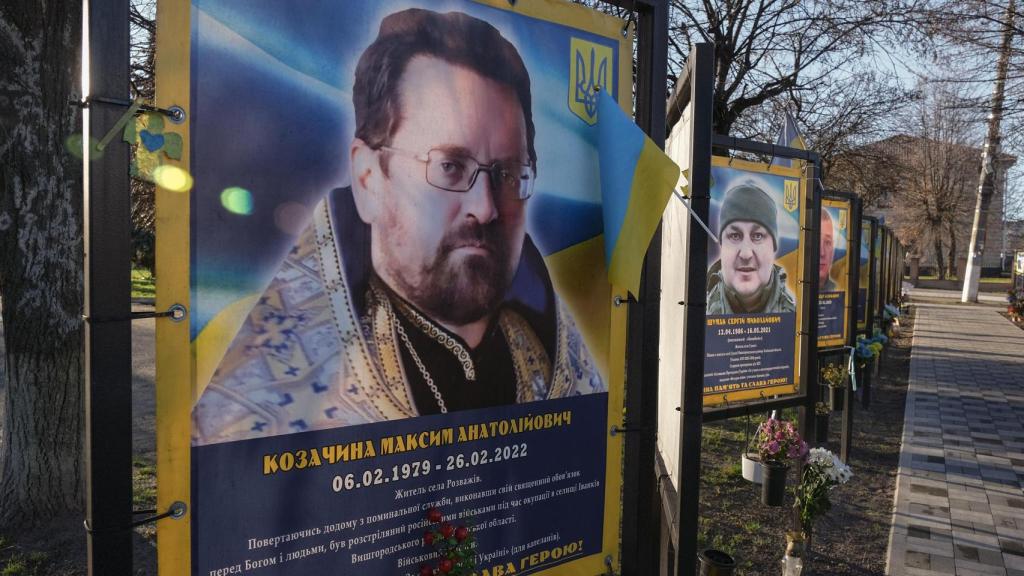
Portrait of Father Maksym, shot by Russian troops when he knelt to prevent their tanks from entering the city of Ivankiv.
Maria Senovilla
It was not an isolated case. In the Ukrainian territories that were liberated during 2022, similar testimonies were collected. “After the evacuation, it became known that many priests of the Moscow Patriarchate helped Russian soldiers, handed over Ukrainian positions and betrayed citizens who supported the country,” says the Ivankiv priest. “And the reaction of the parishioners to that was massive.”
“We have not changed our faith, we have changed subordination to the Moscow Patriarchate,” explains Father Ivan. “The full-scale war definitely opened the eyes of many faithful to the true nature of the Moscow Patriarchate.”
Christmas tree underground
The fact that Russia has bombed many churches – along with schools, hospitals and other facilities that should be a refuge in the midst of the conflict – has also contributed to this disaffection towards the Moscow Patriarchate and its traditions. A silent feeling that is shaking Ukraine, and that grows with each air raid, and with each funeral in which they say goodbye to rows of coffins wrapped with the yellow and blue flag.
And when Christmas comes – and air raid sirens sound more often than Christmas carols – the feeling deepens. All that symbolism that in the rest of Europe evokes joy, gifts and family gatherings around the table, in Ukraine is inevitably tinged with pain.
Because in the underground shelters where hundreds of thousands of Ukrainians are forced to sleep today There are no lights, no trees with balls. And the fact that millions of families are separated, either because women and children live as refugees in other countries, or because parents are in a trench on the front lines – where many have died or been maimed – hurts more these days.
Despite everything, Ukrainians refuse to stop living. AND putting up the Christmas tree has become an exercise in endurance too. We saw it in December 2022, when the majority of city councils put up Christmas decorations – although in a reduced version – despite the Government asking that this not be done, to avoid crowds of people that could be targets of Russian missiles.
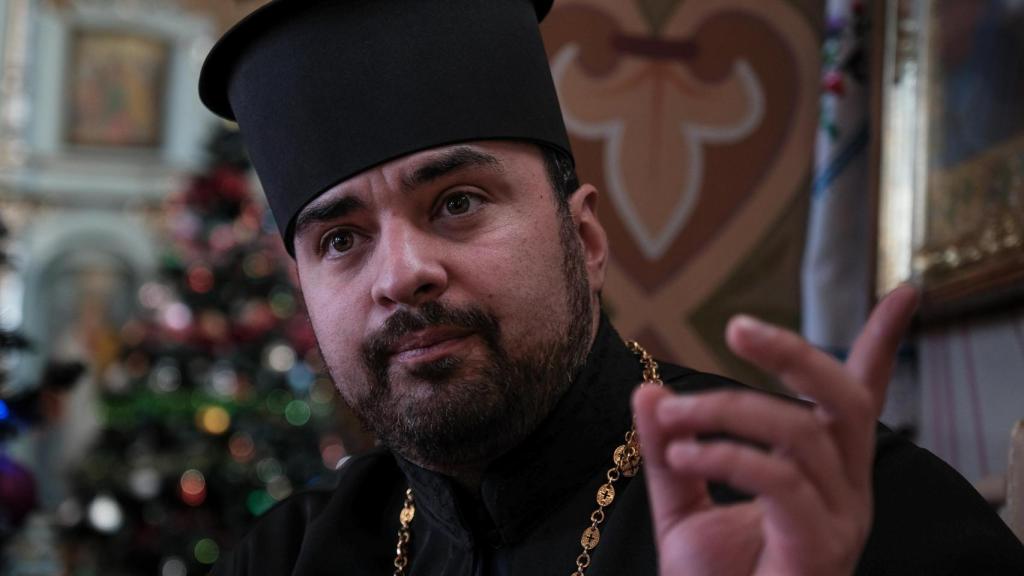
Father Ivan, inside the Orthodox church in the city of Ivankiv, belonging to the Patriarchate of Ukraine.
Maria Senovilla
In 2025, no one prohibits Ukrainians from celebrating Christmas. Last December 6 the state railway company chartered the San Nicolás train for children –following a tradition that is also widespread in northern European countries– for the fourth consecutive year. In the center of Chernigiv a huge nativity scene presides over the central avenue. And there are decorated trees even in Sloviansk, the only city in Donbas where they have dared to install Christmas decorations.
Also the social networks have been filled with these imageswhich even come from the combat front, where Ukrainian soldiers place trees and colored lights inside the trenches, despite the fact that the war has not stopped there because it is December 25.
Celebrating Christmas on this day is not an unimportant detail, it is geopolitical diplomacy. It is also one more element to consolidate the cultural identity of the Ukrainian people, who before the Soviet Union burst into their lives celebrated these dates at the same time as the rest of Europe.
The photo of a priest who was shot by Russian troops in Ivankiv, and who belonged to the Ukrainian Orthodox Church, is today displayed in the Alley of Heroes. And inside the church there are four enormous Christmas trees among which Father Iván celebrated the Midnight Mass on the night of December 24 at the request of the city’s own parishioners. “This war is making more converts than the Church itself,” adds the Ivankiv priest.