
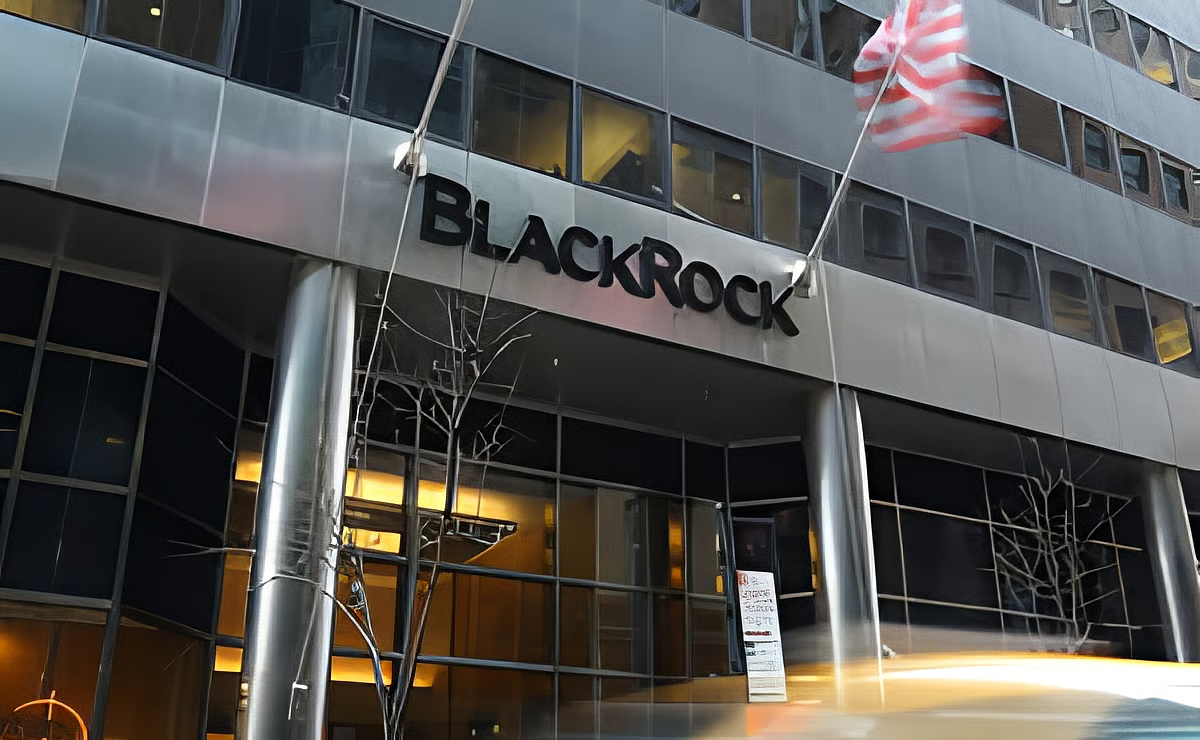

The sale of two ports in Panama to the North American BlackRock is blocked due to China’s demand that the state-owned Cosco hold a majority stake, the Wall Street Journal newspaper reported this Wednesday, 17th.
According to sources cited by the newspaper, the Chinese Government initially protested against the agreement and later demanded that Cosco join the consortium on equal terms. Now, it demands that the Chinese shipping carrier have a greater share than BlackRock or the Swiss MSC, threatening to veto the operation if this condition is not met.
“The negotiations are at an apparently irresoluble impasse”, indicated the sources consulted by the WSJ.
The White House considers any “Chinese control” over the Panama Canal “unacceptable”, claiming that this represents a risk to the national and economic security of the United States.
In turn, a senior Chinese official stated that Beijing wants to include control of these ports in ongoing trade negotiations with Washington.
The initial agreement, announced in March, provided for the sale of more than 40 port terminals operated by CK Hutchison, from Hong Kong, around the world – including the Panamanian ports of Balboa (in the Pacific) and Cristóbal (in the Atlantic) – to the consortium led by BlackRock, for an estimated amount of 23 billion dollars (19.6 billion euros).
The operation was announced weeks after the President of the United States, Donald Trump, criticized the growing Chinese influence over the Canal and threatened to take control of the strategic infrastructure, through which more than 40% of container traffic between the US and Asia passes.
According to the WSJ, Beijing will be able to exert direct influence over the companies involved: both BlackRock and CK Hutchison have relevant businesses in China, and MSC is one of the main maritime carriers of Chinese exports globally.
This is not the first time that China has blocked agreements in the sector. In 2014, Beijing entered into an alliance between MSC, Denmark’s Maersk and France’s CMA CGM, claiming that Chinese commercial interests would be harmed.
According to information released mid-year by the Bloomberg agency, Cosco had already demanded veto power over any decision that went against China’s interests as a condition for joining the consortium.
The deal has become yet another point of tension in the troubled relations between Beijing and Washington. Trump described the agreement as a “regain” of US control over the Canal, while Chinese state media compared it to “giving a knife to the enemy”.