
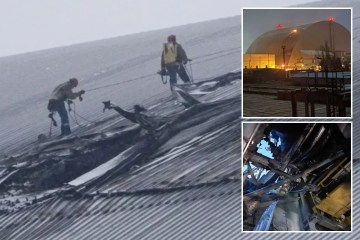

A PROTECTIVE dome which stops radiation leaking from Chernobyl could collapse after it was hit by a Russian drone.
The director of the defunct nuclear power plant has warned that the shelter is now at risk of falling down completely.
Chernobyl director Sergiy Tarakanov said that a further Russian hit could even knock down the inner protective shell.
Tarakanov said: “If a missile or drone hits it directly, or even falls somewhere nearby, for example, an Iskander, God forbid, it will cause a mini-earthquake in the area.
“No one can guarantee that the shelter facility will remain standing after that. That is the main threat.”
The shelter was built to contain radiation from reactor four, which exploded in 1986, causing the world’s worst nuclear meltdown.
DANGER ZONE
Chernobyl protective dome no longer blocking radiation after Russian attack

RUSSIAN MURDER
Widow of first Chernobyl victim killed by drone strike 39yrs after disaster
But a Russian drone strike hit the dome on February 14 this year, inflicting serious damage.
The attack punched a hole in the radiation shield, leading to fears of a radiation leak.
Director Tarakanov warned that fully re-building the shelter could take three to four years.
The hole from the drone hit has been covered with a protective layer, he said.
But the plant director warned that there are still 300 smaller holes in the shelter, made by firefighters as they tackled the blaze.
Tarakanov added that current radiation levels at the site are “stable and within normal limits”.
It comes after fears at the start of this month that radiation would leak through the damaged dome.
The International Atomic Energy Agency (IAEA) said the protective cover had “lost its primary safety functions”.
The February hit punched a hole in the dome, triggering a warning from the IAEA.
Rafael Grossi, IAEA director general, said some repairs had been carried out “but comprehensive restoration remains essential to prevent further degradation and ensure long-term nuclear safety”.
The UN said in February that there had been no reports of radiation leaks and that levels remained stable and normal.
The shelter was designed to arch over a concrete sarcophagus, further sealing off radiation and allowing the safe dismantling of the reactor beneath.
It also acts as a containment zone to trap radioactive dust, using negative pressure and a sealed membrane.
But the outer shelter was never built to withstand the force of a brutal Russian attack.
Artem Siryi, a Ukrainian government official who manages Chernobyl’s shelter, told The Sun: “This project was never designed to deal with a direct military strike. We had to invent solutions on the fly.”
He added: “We were very lucky that the strike did not hit the concrete shelter structure that holds the radiation in.
“If it had landed in a different spot, it could’ve compromised the concrete sarcophagus enveloping the reactor. Then we’d be dealing with a very different situation.”