
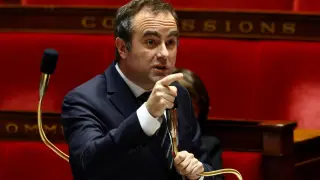

The French State will have general budgets this year 2026. Yesterday, the National Assembly rejected the last two motions of censure with which the extreme right opposition and the non-socialist left responded to the Executive’s decision to adhere to article 49.3 of the Constitution of the Fifth Republic.
The third section of article 49 of the French Constitution is a procedure that allows a Government to approve a text without having a majority in the Lower House. It is the great unblocker, the equivalent of the atomic weapon in the French legislative arsenal.
When a Government takes advantage of 49.3, it commits its fate to the bill in question. The opposition can file a motion of censure that is voted on within the following 48 hours. If it triumphs, the Government resigns. If it fails, the bill is approved.
Scalded by the parliamentary excesses of the Fourth Republic, where governments fell like flies due to the combined action of the oppositions on both sides of the political spectrum, 49.3 gets governments without a majority out of trouble.
On the other hand, unlike in Spain, motions of censure do not include the candidacy of a new prime minister, who in France is appointed by the President of the Republic.
The prime minister Sébastien Lecornu It has passed, counting yesterday’s, six motions of censure. Two, for each of the three times that 49.3 has been used.
The one presented by La Francia Insumisa (LFI; extreme left), the communists and the environmentalists achieved 260 votes. That of the extreme right (of the RN of Marine Le Pen), only 135. 289 were necessary to overthrow the Government.
As usual, the extreme right votes in favor of the censure of the extreme left, but the latter never supports the extreme right’s motion.
The socialists, who announced that they did not support censorship, have saved Lecornu’s Executive in exchange for small budgetary concessions and, above all, the suspension of the pension reform.
Thanks to this resignation, the Government carried out the Social Security financing law in December at the price of increasing the GDP deficit by 0.3%.
Lecornu was named for Emmanuel Macron in September, after his predecessor, François Bayrouwas forced to resign after losing a “suicidal” vote of confidence alleging that parliamentarians were not willing to approve the cuts necessary to recover “a country on the brink of a precipice.”
Bayrou stated that “for 20 years, every hour of every day and every night, the debt has increased by 12 million euros.”
Prime Minister Lecornu promised not to use the 49.3 procedure to carry out the budgets. This is what the socialists asked for in order not to support the immediate censorship with which the insubordinates received them.
Finally, after four months of discussion in the Assembly and the Senate, he was unable to reach a consensus on the support of the socialists in the Lower House and the Republican right that controls the Upper House. So it was decided to forget his promise and go down the middle street, 49.3.
This break of the socialists has been considered by the unsubmissive like a real betrayal.
Your leader, Jean-Luc Mélenchonhas loudly asked at a rally that voters punish the socialists in next month’s municipal elections.
The logic of the socialists led them to break before these elections, a scrutiny that is more favorable to them than the presidential elections, which must be called in the spring of 2027, when Macron’s second term ends.
The accounts approved yesterday place the deficit at 5% of GDP in 2026, against 5.4% in 2025. Initially, the Executive intended to reduce it to 4.6%. The reduction was to come from equal parts spending cuts and tax increases. Finally, the text approved yesterday distributes the reduction in 75% taxes and only 25% cuts in public spending.
The socialists said yesterday that they do not like this budget – in fact, it does not satisfy anyone – but that they have achieved positive social measures such as the generalization of meals in university canteens for one euro. Or the creation of 500 additional jobs in public education for companions of students with disabilities.
The Executive also renounced freezing the income tax rate, which will be revalued by 0.9% in line with the rise in consumer prices.
The high-income contribution is maintained, a tax introduced in the 2025 budget and which will be in force until the deficit drops to 3%.
Singles with incomes greater than 250,000 euros or couples earning more than 500,000 euros will contribute at least 20%.
The text provides, among other measures, for the extension until the end of 2028 of the tax exemption for tips paid by bank card.