
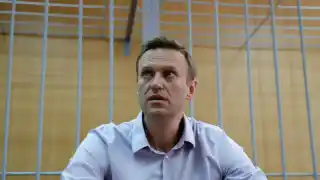

The governments of Germany, the United Kingdom, Sweden and the Netherlands have pointed this Saturday at the Russian Government for the murder of the Russian opponent Alexei Navalny two years ago and have indicated that a powerful neurotoxin originating from a dart frog from Ecuador was used in the attack.
“This is the conclusion of our governments, which is based on the analyzes of Alexei Navalni’s samples. These analyzes have conclusively confirmed the presence of epibatidine,” in reference to the toxin, the foreign ministers of these four governments have pointed out in an official statement released this Saturday.
Epibatidine is a toxin considered a chemical weapon under international legislation, the four governments highlight, recalling that “it is not found naturally in Russia.”
Russia, remember, stated that Navalny died of natural causes, “but given the toxicity of epibatidine and the symptoms reported, poisoning is the cause of his death with a high probability.”
Navalny, remember, was already poisoned in 2018 when he was in Salisbury, in the United Kingdom, with the agent known as Novichok and later again when he was already in prison in the Russian Arctic, according to the statement. “In both cases, only the Russian state had the combined means, motives and disregard for international law sufficient to carry out these attacks,” they noted.
The four European capitals therefore ask that “Russia be held accountable for its repeated violations of the Chemical Weapons Convention” and in this case in particular for its failure to comply with the Biological and Toxin Weapons Convention.
Thus, the representatives of the four countries before the Organization for the Prohibition of Chemical Weapons have written today to its general director, the Spanish Fernando Arias, “to inform him of this non-compliance with the Chemical Weapons Convention.” “We are also concerned that Russia has not destroyed all of its chemical weapons,” they added.
“We and our partners will ensure that all avenues at our disposal are activated to hold Russia accountable,” they said.
After this statement was published, Navalni’s wife, Yulia Navalnaya, highlighted that “scientists from five European countries have concluded that my husband was poisoned with epibatidine, a neurotoxin, one of the deadliest poisons on Earth.”
Navalnaya has highlighted that it comes from the Ecuadorian dart frog and that it causes “paralysis, respiratory arrest and a painful death.” “It was evident from the first day that my husband had been poisoned, but now there is evidence: (Russian President Vladimir) Putin murdered Alexei with a chemical weapon,” she denounced.
Navalny’s wife has expressed her gratitude to the European countries that “have worked meticulously for two years to discover the truth.” “Vladimir Putin is a murderer and must be held accountable for all his crimes,” he appealed.
Navalny died on February 16, 2024 in the FKU IK-3 correctional colony in the Jarp municipality, Yamalo-Nenets Autonomous Okrug, in the Russian Arctic, when he was 47 years old. He had been imprisoned since January 2021, when he returned to Moscow from Berlin, where he had been recovering from Novichok poisoning on British soil.
Moscow, it should be remembered, rejected criticism of his death and asked to wait for the official results of the autopsy. Finally, Sergei Narishkin, director of the Russian Foreign Intelligence Service, attributed the opponent’s death to “natural causes.”
International response
The president of the European Commission, Ursula von der Leyen, said this Saturday that the poisoning of Russian opponent Alexei Navalny “was a cowardly act by a frightened leader”, after the cause of his death was confirmed by the United Kingdom, Sweden, France, Germany and the Netherlands.
“Five European nations have determined that Russia poisoned Alexei Navalny. It was a cowardly act by a frightened leader,” the European leader said in a message on X, where she added that “Russia has long acted as a terrorist state, resorting to terrorist methods: poisoning political opponents, silencing journalists, invading peaceful neighbors.”
Five European nations have determined that Russia poisoned Alexei Navalny.
This was a cowardly act from a frightened leader.
Russia has long acted as a terrorist state, relying on terrorist methods.
⁰Poisoning political opponents.⁰Silencing journalists.⁰Invading peaceful…— Ursula von der Leyen (@vonderleyen) February 14, 2026
“This is the true face of today’s Russia,” said the German politician from the Munich Security Conference she attended this weekend.
In the same message, Von der Leyen honored “the memory of Alexei Navalni and all those whom (Vladimir) Putin’s Russia has violently silenced over the years.”