

According to the government official, the executive is “taking” his share, “without writing a check to any specific company” and “ensuring that everyone does their part”, with “conditions of competition, openness, transparency”, in order to “help contribute to a solution”.
“I believe that sooner rather than later there will be answers about what the Government’s concrete proposals are for this solution”, he indicated, noting that any solution must “make the sector co-responsible”.
According to Leitão Amaro, any solution involves “resorting to some form of partnership”, but he recalled that The products are produced by “media companies” which, therefore, must be “co-responsible”.
Leitão Amaro guaranteed that the Government “shares the concerns” regarding the lack of access of part of the population to the written press.
“There is a reason for social and territorial cohesion for the State to be concerned and act so that people in the interior and older people, many of them in the interior as well, can continue to have access to the written press. That is why we doubled the postage paid, from 40% to 80%, with an expected expense of 4.5 million euros”, he highlighted.
The minister admitted that there is a part of the population, “because they are in the interior”, and another that “does not have the same literacy and digital access” typically older people who still “need the paper press”.
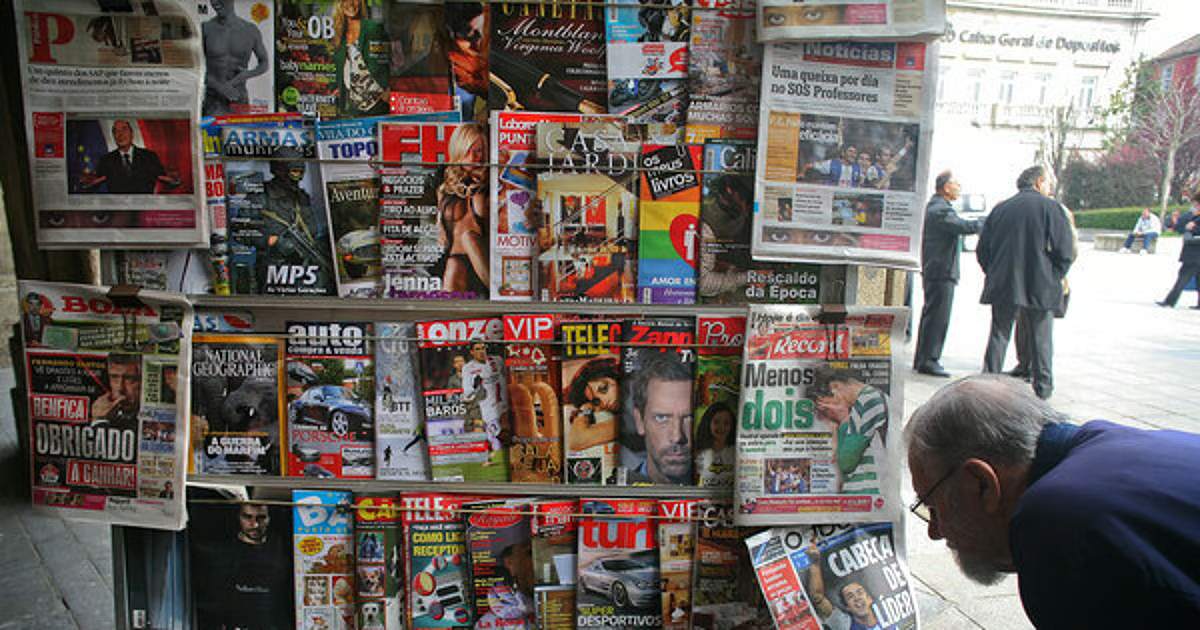
At the beginning of the month, Vasp’s administration reported that it is evaluating the need to make adjustments to the daily distribution of newspapers in the districts of Beja, Évora, Portalegre, Castelo Branco, Guarda, Viseu, Vila Real and Bragança.
In a statement, Vasp said that “it is currently going through a particularly demanding financial situation, resulting from the continued drop in press sales and the significant increase in operating costs, which put the sustainability of the current daily press distribution coverage under severe pressure”.
This situation “has a direct impact on the viability of daily press distribution at points of sale, especially in the interior regions of the country, forcing the company to reevaluate its operational and logistical model”, says Vasp – Distribução e Logística, on the day that Correio da Manhã reports that there is “eight districts at risk of running out of newspapers from January onwards”.
The company “unequivocally reaffirms its commitment to universal access to information, understanding it as an essential pillar of territorial cohesion, equal opportunities and the full exercise of democratic citizenship”, adding that “restricting this access unfairly penalizes populations in low-density territories and deepens regional asymmetries”.
Despite this commitment, “and maintaining full respect for the agreements entered into with publishers and points of sale, the company is forced to study a review of the current configuration of some distribution routes, in order to safeguard the global continuity of the operation and avoid a scenario of financial unsustainability that would put the entire press distribution activity in Portugal at risk”.