
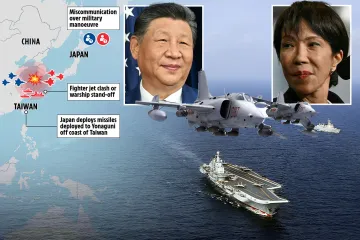

CHINESE warships are massing near Taiwan, as staggeringly clear satellite photos reveal the true strength of the armada.
The brazen display by China in disputed waters show two destroyers, a landing helicopter dock ship, a replenishment ship and a helicopter in flight.
One of the vessels has been identified as the Hainan, the largest amphibious warship in the Chinese navy.
The others are equally as deadly, identified as Jiangkai II, a guided-missile frigate, the Yan’an Type 055 destroyer and the Luomahu replenishment ship.
The frightening naval muster in the Philippine Sea has sparked concern among Beijing’s neighbours.
This week defence officials confirmed a Royal Australian Air Force P-8 Poseidon surveillance plane closely tracked the People’s Liberation Army-Navy flotilla.
COMING STORM
Three ways China and Japan could trigger WW3 as tensions explode over Taiwan

WW3 DRILLS
China launches terrifying rehearsal for INVASION of Taiwan using ‘shadow fleet’
Activity was tracked from the Yellow Sea, near the disputed Senkaku Islands in the East China Sea, into the Taiwan Straitthe South China SeaWestern Pacific and Philippine Sea.
It appears to be a way for China to stake territorial claims around Taiwan, the self-governing island that Beijing says must come under its rule.
US company Vantor collected the images on December 3 and is the clearest public view of China’s maritime expansion.
It’s the latest tactic by Beijing to put pressure on self-governing Taiwan, though it’s not the first time China has asserted its dominance in the sea.
Last year in December, Taiwan raised its alert level when China’s mass naval was deployed, though sources told Reuters that this year’s operation exceeds the last time.
In Tokyo, Shinjiro Koizumi, the defence minister, said on Friday that Japan was watching the Chinese military movements “with great attention”, The Telegraph reported.
Without commenting on the specific deployment, he said Japan was deeply concerned with how “China has been expanding and stepping up its military activities in the areas surrounding Japan”.
Amid an escalating war of words sparked by Tokyo’s comments on Taiwan, experts reveal how knife-edge relations could spiral into a direct military confrontation with one wrong move.
The furious row between Asia’s two biggest economies has erupted over Taiwan, the self-governing island that China says must come under its rule.
Japan’s Prime Minister Sanae Takaichi infuriated Beijing by saying Tokyo could respond militarily if China were to try to seize control of Taiwan.
Beijing, which has threatened to use force to take control of the island, responded furiously to Takaichi’s remarks.
It summoned Tokyo’s ambassador and advised Chinese citizens against travelling to Japan.
Then, the row escalated after Tokyo said it would push ahead with the planned deployment of missiles on Yonaguni, an island close to Taiwan.
China said the plan was a “deliberate attempt to create regional tension and provoke military confrontation”.
And it warned Japan will have to pay a “painful price” if it steps out of line over Taiwan.
Now, experts have warned that the war of words marks a “very dangerous” situation in the region.
Why does China want Taiwan?
Sovereignty and nationalism: The PRC regards Taiwan as a part of China since 1949 and frames reunification as correcting the legacy of civil war and foreign interference. It’s tied to the narrative of “national rejuvenation” by 2049.
Strategic security: Control of Taiwan would push China’s defensive perimeter outward, complicate foreign (especially US) military operations close to its coast, and help break the “first island chain” that constrains the PLA Navy and Air Force.
Regional influence and deterrence: Unification would signal that China can reshape the regional order and deter other separatist movements, reinforcing Beijing’s credibility at home and abroad.
Economic and technological considerations: Taiwan is a key link in global supply chains, particularly semiconductors. While Beijing emphasises sovereignty over economics, control of these capabilities would have strategic benefits.
Domestic legitimacy: Advancing reunification supports the CCP’s claim to be restoring China’s greatness, which is politically valuable for leadership cohesion and public support.