
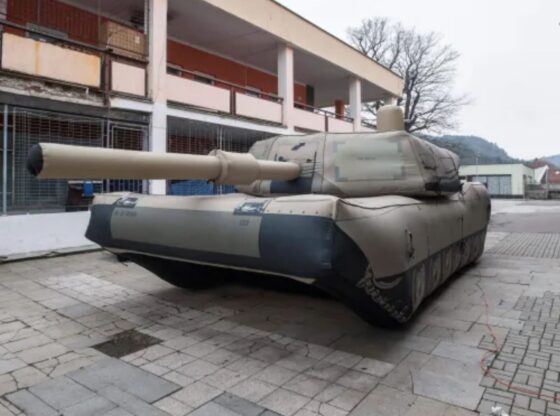

FROM inflatable tanks to painted jets and even war camels, the Russians have used some of the barmiest tactics to wage a war of deception against Ukraine.
Throughout the conflict, which has been raging for almost four years now, Moscow’s troops have deployed a wide range of fake weapons to mislead the enemy and sow chaos.
Russian deception tools are based on a long-standing military doctrine called “Maskirovka”, which encompasses a range of physical, technical, and informational techniques designed to confuse and mislead an enemy.
Entire brigades of knock-off armies and blow-up weapons are all examples of Vladimir Putin’s trickery and deceit.
But they also serve as clever tactics to get ahead on the battlefield.
Military analyst Phlip Ingram said that these tactics have been a part of warfare since the Second World War.
He told The Sun: “It is a simple but brilliant way to deplete enemy ammunition and expose their positions.”
One of the most bizarre weapons used by the Russian army is inflatable military equipment.
Throughout the war, Russia on multiple occasions used tanks and other military vehicles, which in reality are just inflatable toys that look identical.
These decoys are a low-cost, rapidly deployed way to confuse enemy reconnaissance, waste ammunition, sow confusion, and draw fire away from real targets.
They are designed to look like a genuine threat on radar, forcing Ukrainian air defences to expend valuable and expensive anti-aircraft missiles, which can cost hundreds of thousands of dollars each, on a target that costs significantly less.
Other examples include camouflage tactics, such as jets painted on tarmacs.
There have also been a few instances where the Russian army has reportedly used mannequins to make up fake army battalions.
A significant psychological impact of this strategy is that it forces your enemies to overestimate your capabilities.
When troops encounter what seems like a significant build-up of Russian assets, they may assume they are facing a much larger force than in reality.
This misperception can sow chaos and divert the enemy resources from genuine threats, stretching their logistical capabilities.
Mr Ingram said: “The Russian use of deception, whether it be painting shadows of aircraft on tarmac, or trying to disrupt the radar signatures of aircraft by putting tyres on their wings and everything else, is a recognised tactic of war.
“Even Allies created a complete fake army as part of Operation Fortitude.
“And that was to convince Hitler that we had the majority of our troops ready to attack through the Pas de Calais, whilst the real D-Day landings were being prepared to go in through Normandy.
“So deception has always been a part of warfare.”
But the barmiest of all are the converted “turtle tanks” with a heavily armoured, low-profile design resembling the shape of a turtle.
The term isn’t specific to a single model but can describe various tanks known for their strong armour and defensive capabilities.
One prominent example is the German Panzer VIII Maus, the heaviest fully enclosed armoured fighting vehicle ever built.
Another is the Soviet KV-2, known for its thick armor and large turret.
The design philosophy behind these tanks focuses on maximum protection and survivability on the battlefield, often at the cost of speed and mobility.
Russian tanks have appeared underneath the turtle shell-like cages after it was revealed that Putin embarrassingly lost almost all of the tanks he had since invading Ukraine.
Pictures show steel sheds covering almost the entire tank, leaving a gap at the front for the turret to fire at enemy troops.
But visibility and field awareness from inside the mechanical beasts are surely hampered as a result.
Footage has also shown Ukrainian troops rescuing a camel which was being used by the Russian army.
In one instance, a seven-foot, one-tonne Bactrian camel was seen galloping through eastern Ukraine behind a white pick-up truck full of soldiers.
The camel was found and taken in by Ukraine after they stormed a Russian position in the war-torn region.
But while it may seem like a desperate measure by the Russian troops, it is actually a smart tactic, according to Mr Ingram.
He said: “There are very often conditions where vehicles can’t get everywhere, and you still need to haul heavy ammunition like mortars, artillery pieces, and other things around.
“So the use of horses, the use of donkeys, the use of camels are actually a brilliant way to carry on.
Because Ukrainian mud is one of the best anti-armour capabilities that’s out there.
“It sucks tanks into the ground. It does the same with any wheeled vehicles.
“And with people walking across it, it’s very difficult, which is why we’ve seen Russian tactics change to small groups of people on foot, or possibly on small motorbikes, or all-terrain vehicles.
“But again, people on foot can’t carry loads over long distances, and the front line now is 10 to 15 kilometres deep.
“So it’s what I would expect militaries to be doing, given the conditions that there are in certain parts of the front line.”