

The Danish Ministry of Defense dusted off an ordinance dated 1952 that legally obliges its troops to “engage in combat without waiting or requesting orders, even if the commanders concerned are not aware of the declaration or state of war.”
Put into practice, the document presupposes that, in the event that the United States attempts to take public buildings in Nuuk by force or carry out military action elsewhere on the island, the worst-case scenario that Donald Trump draws based on threats, the Danish soldiers will have to respond by opening fire.
“If the United States decides to attack another NATO country militarily, then everything stops,” the Danish Prime Minister warned this Monday. Mette Frederiksenin statements to the public channel TV2. “That is, including our NATO and therefore the security that has been guaranteed since the end of World War II.”
The diary Berlingske confirmed last week that the order to counterattack, designed after Nazi Germany’s attack on Denmark in April 1940, remains in force. The Arctic Command, the Danish military’s extension on the island of 57,000 inhabitants, is aware of its existence.
But this risk factor does not change Trump’s position, determined to take control of Greenland “by hook or by crook”, a territory fifty times larger than Denmark. “One way or another, we’re going to have Greenland,” he reiterated Sunday to reporters aboard Air Force One.
The great unknown is knowing what would happen in the event of an invasion. “The allies could then support Denmark with the actions they consider necessary, but that does not automatically imply the use of armed force,” he responds in conversation with this newspaper. Christoph Harigassociate professor at the Royal Danish Defense College, who avoids entering the realm of speculation.
Harig is only clear that, “by asking allies to defend one ally against another ally, NATO would experience an existential crisis.”
Denmark could invoke Article 5 of the Alliance, but, as explained Ulrik Pramsenior researcher at the Danish Institute of International Studies (DIIS), that initiative “would be meaningless because NATO works by consensus, so the United States has a veto.”
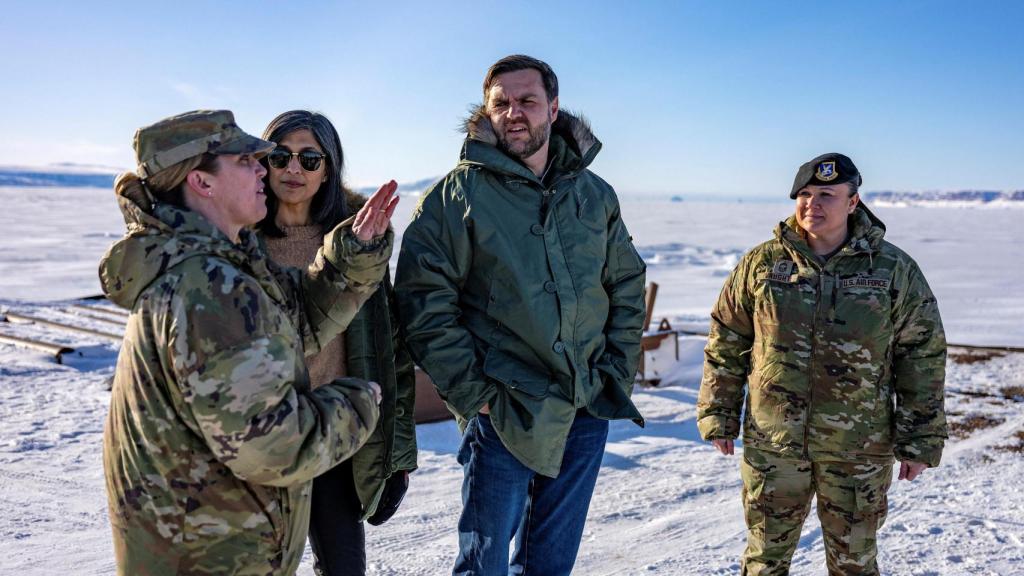
The commander of the US military base in Pituffik, Greenland, Susannah Meyers, with the US Vice President, JD Vance, during her visit on March 29.
Reuters
Priority, again
Washington played an essential role in the defense of the island for decades. “Since the Second World War there has been a division of labor: Denmark was in charge of the coast guard and patrolling the uninhabited northeast, while the United States is in charge of policing the domain in order to defend the North American continent against Russian nuclear weapons,” notes Pram Gad, citing the 1951 defense agreement.
“But after the end of the Cold War, the United States withdrew most of the radars; now it wants Denmark to assume that responsibility,” recalls the specialist.
In addition to rendering the radars unusable, the Pentagon closed sixteen of the seventeen military installations it controlled on the island. Only the Pituffik space base remains open, which the vice president J.D. Vance decided to visit in March of last year, and just over a hundred troops.
Now, Trump justifies his annexation plans using national security reasons, related to the growing presence of Russia and China in the Arctic Circle. An argument that Mark RutteSecretary General of NATO, shared without evaluating the annexation threats of the tenant of the White House against another of the Alliance partners.
“With the opening of new sea routes, there is a risk that the Russians and the Chinese will become more active,” commented the former Dutch minister from the Croatian Pleso air base. Like Rutte, a group of European leaders led by the German chancellor Friedrich Merz and the British Prime Minister Keir Starmer They aim to show Washington that they are also concerned about threats to Greenland’s security.
That’s why they study, according to Bloombergestablish a joint NATO mission on the Arctic island. They consider that, in this way, both Trump and his court advisor Stephen Millerthe brain behind the territorial claims, will stop believing it is necessary to take over the sovereignty of Greenland.
A real scenario
Many remain convinced that the White House will not go that far. According to the French Minister of Foreign Affairs, Jean-Noel Barrothis American counterpart, Marco Rubiohad ruled out the possibility of invading Greenland.
Other European voices that distance this scenario are that of Peter Mandelsonthe former British ambassador to the United States, marred by the scandal of Jeffrey Epsteinwho considers however that “we are all going to have to wake up to the reality that the Arctic needs to be protected against China and Russia. And if you ask me who is going to lead that effort to protect it, we all know, don’t we?, that it is going to be the United States.”
The public messages disseminated by the White House point in another direction, however. Harig takes it seriously, even though it is “more likely that non-military means will be attempted to take over Greenland”, such as purchasing the territory, an option preferred by Trump.
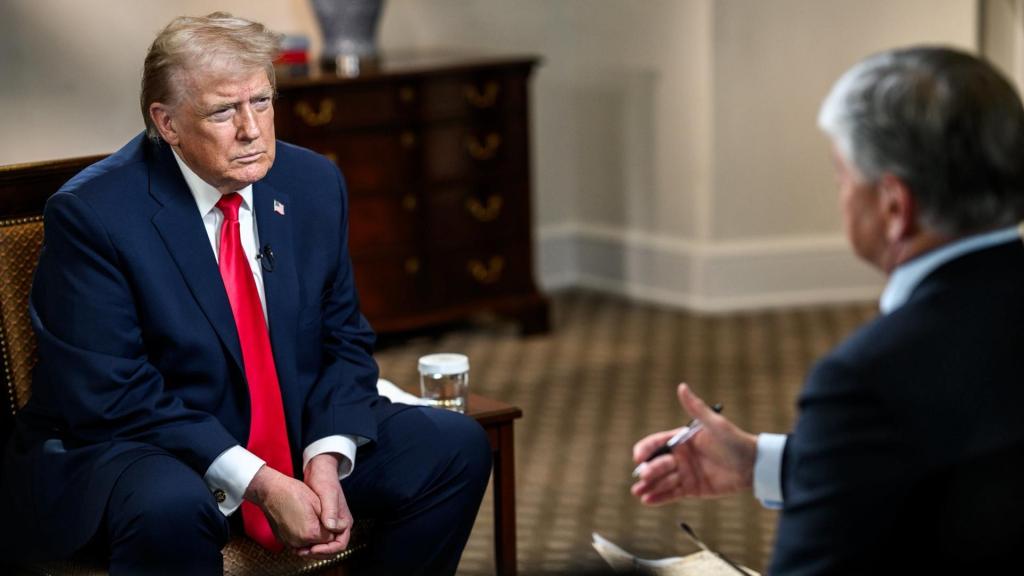
Donald Trump, during an interview with journalist Sean Hannity this Thursday, in Washington.
White House
“Trump’s entire second presidency offers sufficient evidence that even some of his most radical ideas could be implemented,” says the associate professor at the Royal Danish Defense College, who believes that “the US military would not disobey such orders, given that it has historically carried out other controversial ones, including military operations such as the capture of foreign leaders or the extralegal elimination of alleged drug traffickers.”
Pram Gad would not be surprised by this scenario either, given that Trump “wants to go down in history.” Annexing Greenland to the United States would, without a doubt, be his great legacy.