
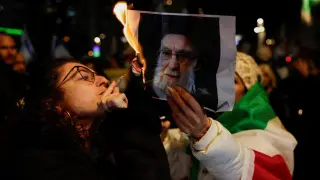

All the signs indicate that the attack of Donald Trump in Iran it is imminent. The Republican president is accelerating preparations for an offensive against Iran in a paradoxical context: he has sufficient military architecture to strike, but lacks—for now—the political and logistical support that Gulf partners normally provide.
“Time is running out,” Trump wrote, accentuating the urgency, calling on Tehran to accept a deal “without nuclear weapons,” while warning that “the next attack will be much worse.”
The Trump Administration is also trying to cement the “opportunity” narrative: Marco Rubio He declared this Wednesday before the Senate that the Iranian Government is “probably weaker than ever,” with the economy “in collapse,” and estimated that “thousands, for sure,” have died in the protests, predicting that the outbreaks will return.
This framework is functional to justify maximum pressure: Iran would be weakened outside – after previous blows – and stressed inside, which, in theory, would reduce the cost of forcing concessions.
It would be a limited attack designed to coerce, punish and force changes in behavior, rather than to open an all-out war. There are certain parallels with Venezuela, but the Islamic Republic presents greater complexity and gigantic challenges.
For starters, regional powers, like their Gulf allies, have announced that they will not participate. Türkiye, a NATO member, is fearful and fears a regional escalation. Israel is delighted.
The Gulf’s refusal is not out of sympathy for Tehran, but rather responds to a cold calculation: in 2019, Iran hit Saudi oil facilities, and Riyadh and Abu Dhabi have been recurring targets of attacks by Iran or its allies.
In the words of Karim Sadjadpouranalyst at the Carnegie Endowment for International Peace, a prestigious think tank based in Washington, both would prefer a “degraded and less threatening” Iran, but fear retaliation and regional destabilization and do not want to be “the tip of the spear” of the United States.
The Saudi-Emirati refusal does not make American action impossible, but it “Americanizes” it. Former senior officials cited by The Wall Street Journal They warn that it complicates planning, forcing them to rely more on embarked aviation and long-range assets—including the option of bombers from outside the Gulf, or bases like Diego Garcia—, in addition to deployments in Jordan.
Türkiye says no
The other regional actor that is trying to slow down—for different reasons—is Türkiye.
An analysis of Iran International describes how Ankara sees the current cycle of protests and repression not as a “fight for freedom”, but as a geopolitical risk: Iran functions as a “buffer state” that has helped stabilize its eastern border for decades, and its weakening could open the door to militancy (PKK/PJAK, considered terrorist groups by Ankara) and new flows of refugees, with the Syrian precedent as a strategic trauma.
The Turkish president, Recep Tayyip Erdoganconveyed to his Iranian counterpart, Masud Pezeshkianhis opposition to any foreign intervention, and that the Turkish reflex is to preserve the the state in which for fear of what comes next: a power vacuum, armed enclaves and a prolonged security burden.
On this board, Israel appears as the most likely exception: it is the regional partner with the greatest interest in a coup that lastingly degrades the Iranian nuclear program and missile capacity.
But even there there is room for tactical ambiguity: political and intelligence support does not necessarily equate to a visible joint operation, especially if Washington intends to maintain control of the pace of escalation.
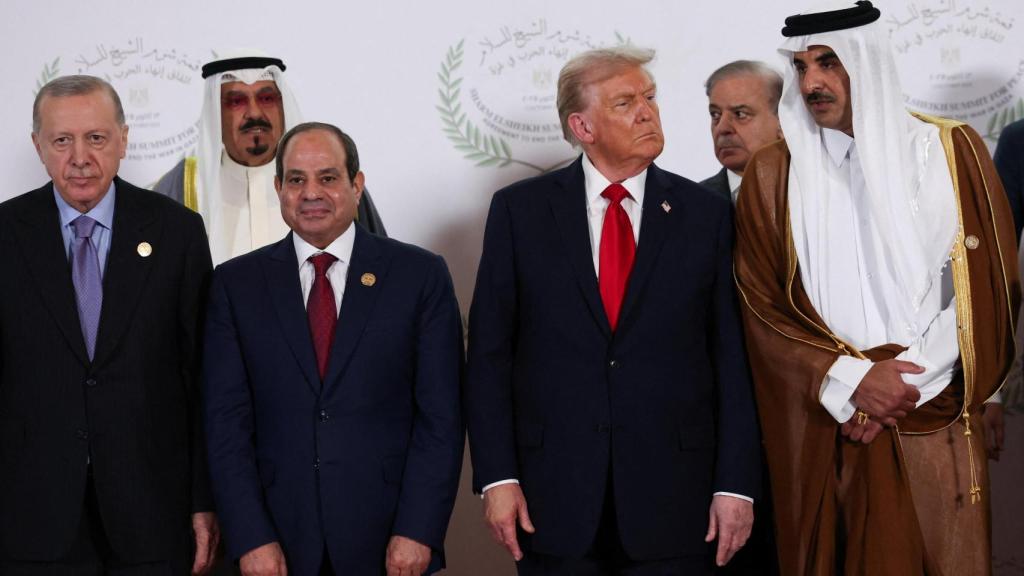
Erdogan, left, in a photo shared with other summit participants,
Reuters
Russia and China do not seem too strong to act, and the European Union issues emphatic statements against the civil repression by the ayatollahs, which has already accumulated thousands of deaths. Strong European statements, very strong, but inane. Brussels also believes that US intervention is imminent, with a window of days.
Washington is trying to impose costs and deterrence against the repression of the civilian population and against the Iranian nuclear program. Tehran seeks to resist without giving in to threats. The operational theater of this possible escalation is the bases, militias and the air and maritime spaces of the Persian Gulf, Iraq and Syria, with immediate collateral effects on the energy routes of Hormuz and, by extension, Europe.
The signs are there. Trump has verbalized one of those ultimatums that precede his lightning interventions, with his logic of “either agreement or punishment”, while deploying the aircraft carrier USS Abraham Lincoln in the region, which gives him the ability to strike without depending on the Gulf air corridors.
Meanwhile, the risk of asymmetric retaliation, which often precedes Trumpian punitive blows, increases. Iran-aligned militias in Iraq and Yemen are threatening to intervene with naval deployment.
Iran is not Venezuela
But Iran is not Venezuela. To begin with, the Revolutionary Guard, the IRGC, is very powerful and all-powerful: of the almost 800,000 security and military personnel of the Islamic Republic, the IRGC controls almost half, and its tentacles extend throughout the economy, industry and the coercive apparatus.
A surgical removal of Supreme Leader Ali Khamenei would not dismantle the structure of the regime.
Kaveh Nematipouran exiled Iranian activist, also adds the internal challenges in the event of a White House intervention: the window is short but the outcome is uncertain. It highlights two indicators that together tend to anticipate action: contradictory signals from Washington – threats and containment – that keep the Iranian regime cautious, and evidence that the largest US aircraft carrier is moving towards the waters of the Gulf.
Nematipour argues that the apparent strategic weakness does not imply fragility of coercive power: he describes a system converted into an armed and organized oligarchic “class”, anchored in institutions under the supreme leader, with the IRGC as the economic and repressive backbone.
Its central thesis is that, without significant defections and without an articulated internal opposition, the country can fall into a cycle of protests-blackout-repression-selective executions-new outbreak; and that external factors—mixed signals from Washington, caution from neighbors—may push toward violent instability rather than toward a clean transition.
That warning fits the Iranian academic Fatemeh Shamswho describes these protests as a revolt of economic survival: currency decline, inflation, shortages and business closures, with strikes and greater social outreach than in previous rounds; Furthermore, it places the deterioration of the regime in the weakening of its regional network and in the perception of humiliation due to the previous war.
For Washington, that deterioration may seem like a window; For neighbors, it is a threat of overflow.
Risks
The immediate risk, if Trump strikes without a broad regional umbrella, is that Iran responds asymmetrically where it hurts the most and where it costs the least.
Al-Monitor cites a warning from the naval IRGC: if the soil, sky or waters of neighboring countries are used against Iran, they will be considered “hostile.”
That phrase explains why the Gulf is moving away: they do not want to become targets by proxy. And it also explains why an operation “without allies” can be more dangerous for the allies, precisely because it reduces their ability to influence the design and containment of the attack.
“What type of attack does Trump suspect? Three hypotheses dominate, and all three depend on the same constraint: making it viable without the Gulf.
The first is a coercive and brief coup, designed to force negotiation under pressure, with military and command objectives.
The second is a broader degradation campaign (defenses, missiles, IRGC nodes), which greatly increases the risk of sustained regional response.
The third, intermediate, are precision attacks on high-value figures or nodes.
In all cases, Nematipour’s warning—”a social class does not bombard itself with fighter jets”—serves as a corrective: destroying capacity is not equivalent to producing transition.
The comparison with Venezuela, which Trump has waved in statements—”bigger than Venezuela”—is tempting as propaganda, but misleading as analysis.
Iran has regional and maritime retaliation capacity, strategic depth and a network of armed actors that multiplies points of friction. Furthermore, an attack can provide the regime with an alibi to nationalize the conflict and justify even harsher repression, reframing the protests as “foreign interference.”
The countries most negatively affected would be, in order of presentation: Iraq, the petro-monarchies of the Gulf, and the Hormuz-Red Sea maritime axis.
Turkey would be on the front line of the “post-attack” effects if the regime weakens without collapsing: migratory pressure, reactivation of Kurdish militancy and a new unstable border, just when Ankara seeks to consolidate its own internal process with the PKK.
Europe, although it is not a military objective, would pay part of the bill via energy, imported inflation and logistical disruption.
The conclusion is less epic than the ultimatum language suggests. Trump is building the political framework to strike and has the military muscle to do so. But the Gulf and Türkiye, each due to their fears, are distancing themselves so as not to be co-protagonists or hostages of the Iranian retaliation.
A military offensive without allies is feasible, but politically more dangerous and strategically less controllable.